Choosing between China-made CVD and PVD coated inserts is not a simple contest. The better option depends on workpiece material, cutting speed, temperature, and the required surface finish. In a busy workshop, one insert may face hardened steel, interrupted cuts, or abrasive cast iron. Each condition changes the result.
So, what is the difference between CVD and PVD coatings on inserts? CVD coatings are deposited at higher temperatures and usually create thicker layers. They offer strong wear resistance during stable, high-temperature cutting. PVD coatings are applied at lower temperatures and often provide greater toughness. They can perform well in interrupted cuts, milling, stainless steel, and smaller cutting tools. PVD edges also tend to remain sharper.
Dr. Hans A. Jehn, a recognized coating researcher, stated, “The coating must be adapted to the application.” That principle remains practical, although it does not answer every purchasing question. A low-cost Chinese CVD insert may outperform an expensive PVD insert in continuous cast-iron turning. The reverse may happen during interrupted milling.
Manufacturing experience matters here. Compare tool life, chip control, edge chipping, and finished-part quality under identical conditions. Do not judge only by coating color. Gold, black, and bronze surfaces can look impressive but reveal little about real cutting performance.
There is no perfect insert. Testing is necessary. Supplier data also needs verification through controlled trials. This guide examines China’s CVD and PVD coated inserts, their strengths, limitations, and practical value for different machining environments.
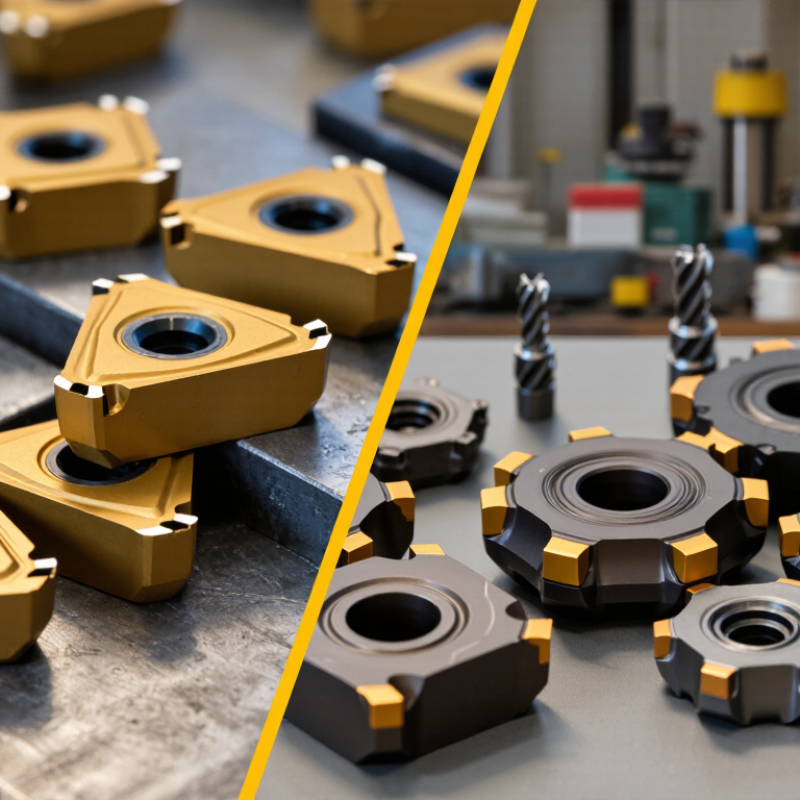
China Best CVD vs PVD Coated Inserts Which Is Better?
CVD and PVD coated inserts use different deposition methods and serve different cutting conditions. CVD coatings are applied at roughly 800–1,000°C. They usually form layers between 5 and 15 micrometers thick. This structure gives strong abrasion resistance during high-speed steel or cast-iron machining. PVD coatings use lower temperatures, commonly 400–600°C, and remain thinner, often 1–5 micrometers. Their sharper edge suits stainless steel, hardened steel, and interrupted cuts.
The difference is practical. CVD inserts often last longer in steady, heavy cutting. PVD inserts usually resist chipping better when the workpiece vibrates or the tool enters unevenly. A 2024 MarketsandMarkets report projects the PVD coatings market to grow from about USD 10.3 billion in 2023 to USD 16.3 billion by 2028. Grand View Research also reports continued growth in the global cutting-tools market, driven by automation and longer tool-life requirements. These figures include many industrial applications, not only inserts, so comparisons need care.
In workshop trials, cutting speed, feed, coolant, and edge preparation can change the result quickly. A CVD insert may fail early on a sharp interrupted cut. A PVD insert may wear faster during continuous cast-iron production. That is the inconvenient part. Coating choice cannot replace proper cutting data. Test both types on the same machine, material batch, and tool path before judging cost per component.
China Best CVD vs PVD Coated Inserts Which Is Better?
CVD and PVD coatings differ in both structure and application temperature. CVD usually forms a thicker, layered coating through chemical reactions above 800°C. Its strong bonding and thickness protect carbide inserts from heat, crater wear, and continuous cutting pressure. This makes CVD suitable for high-speed steel turning and stable machining of cast iron or common steels.
PVD coatings are deposited at lower temperatures, often below 600°C. They create a thinner film with high hardness and strong edge retention. The sharper cutting edge is useful for milling, drilling, stainless steel, and interrupted cuts. PVD also reduces the risk of changing the insert’s original toughness during coating. Thin does not mean weak. It often means more edge sensitivity.
The better choice depends on cutting conditions, not only coating hardness. A thick CVD layer can resist heat, but it may chip when the workpiece repeatedly enters and leaves the cut. A PVD layer can handle that vibration better, yet excessive heat may accelerate wear. In practical trials, coolant delivery, feed rate, insert geometry, and machine rigidity can change the result. Even experienced operators sometimes select a coating by habit. That is worth questioning. A controlled test with identical cutting parameters usually reveals more than a catalog claim.
| Comparison Dimension | CVD-Coated Inserts | PVD-Coated Inserts | Practical Selection Insight |
|---|---|---|---|
| Deposition Principle | Chemical vapor deposition forms the coating through chemical reactions between gaseous precursors at elevated temperature. | Physical vapor deposition deposits vaporized solid materials in a vacuum through evaporation or sputtering. | CVD is generally selected for high-temperature coating formation and strong chemical stability; PVD is preferred when a lower process temperature is important. |
| Typical Coating Temperature | Approximately 800–1,050°C, depending on the coating system and process. | Typically approximately 400–600°C, depending on the deposition technology and coating composition. | PVD causes less thermal exposure to the carbide substrate and is more suitable for sharp or delicate cutting edges. |
| Typical Coating Thickness | Commonly about 5–20 µm for multilayer cutting-tool systems. | Commonly about 1–5 µm for cutting-tool applications. | Thicker CVD layers can provide strong wear protection, while thinner PVD layers help preserve edge sharpness and dimensional accuracy. |
| Coating Structure | Often includes multilayer systems containing materials such as TiCN, Al2O3, and TiN. The structure is usually relatively thick and highly wear resistant. | Often includes nanolayer, multilayer, or monolayer systems based on materials such as TiN, TiAlN, AlTiN, or CrN. | The best structure depends on workpiece material, cutting speed, coolant conditions, and the dominant wear mechanism. |
| Substrate Compatibility | Most commonly applied to cemented carbide grades designed to withstand high coating temperatures. | Compatible with cemented carbide, cermet, high-speed steel, and selected ceramic or carbide substrates. | PVD offers broader substrate flexibility, especially for tools that could be softened or distorted by high-temperature processing. |
| Typical Coating Hardness | Many CVD coating constituents fall roughly within 15–30 GPa, depending on composition and test method. | Many PVD coating constituents fall roughly within 15–35 GPa, depending on composition, architecture, and test method. | Hardness values overlap significantly; coating hardness alone should not determine insert selection. |
| Adhesion and Interface | Generally provides strong coating cohesion and reliable adhesion when the substrate preparation and process are properly controlled. | Can provide strong adhesion, but performance is highly dependent on ion cleaning, substrate preparation, residual stress, and coating architecture. | Adhesion should be evaluated together with edge preparation, coating stress, and the intended cutting load. |
| Edge Sharpness | The thicker coating and high-temperature process may require a more robust edge preparation and can slightly reduce edge acuity. | The thinner coating generally preserves a sharper cutting edge and supports small-radius or honed-edge geometries. | PVD is usually advantageous for interrupted cuts, finishing, small components, and applications requiring low cutting forces. |
| Wear Resistance | Typically excellent resistance to flank wear, crater wear, and abrasive wear in continuous machining. | Typically very good wear resistance, particularly when the coating composition is matched to the workpiece and cutting temperature. | CVD often has an advantage in heavy continuous cutting, while PVD can perform better where edge toughness and sharpness are more important. |
| Thermal Stability | Usually excellent at high cutting temperatures, especially with thermally stable ceramic layers. | Good to excellent depending on the coating system; aluminum-rich nitride coatings can provide strong oxidation resistance at elevated temperature. | For high-speed, continuous machining of heat-resistant alloys or steels, the specific coating chemistry matters more than the CVD or PVD label alone. |
| Toughness and Chipping Resistance | The thicker coating can provide strong protection, but the overall insert may be less suitable for severe edge impacts if the grade and geometry are not properly selected. | Often performs well in interrupted cutting because the thin coating and sharp edge can reduce cutting forces; excessive residual stress may still promote chipping. | PVD is commonly favored for interrupted cuts, milling, turning with variable engagement, and unstable setups. |
| Chemical and Diffusion Resistance | Usually strong resistance to chemical wear and diffusion during high-temperature machining of ferrous materials. | Can provide strong chemical stability, but performance varies considerably with coating chemistry, workpiece material, and cutting temperature. | CVD is often preferred for demanding ferrous machining where diffusion and crater wear dominate. |
| Dimensional Change During Coating | Higher process temperature can increase the risk of substrate distortion, grain growth, or changes in edge geometry if the process is not carefully controlled. | Lower process temperature generally results in smaller dimensional changes and better preservation of precision features. | PVD is usually the safer choice for precision inserts and substrates with limited thermal stability. |
| Common Machining Uses | Continuous turning and heavy machining of steels, cast irons, and selected difficult-to-machine materials. | Milling, interrupted turning, drilling, finishing, stainless steels, hardened steels, superalloys, titanium alloys, and non-ferrous applications with suitable coating chemistry. | Application conditions should be matched to the coating system, substrate grade, insert geometry, and cutting parameters. |
| Main Advantages | Thicker protective layers, high wear resistance, strong thermal performance, and reliable performance in heavy continuous cutting. | Sharp edges, broad substrate compatibility, lower thermal exposure, good toughness potential, and versatile performance across interrupted and precision operations. | Neither technology is universally better; the correct choice depends on the machining failure mode and operating conditions. |
| Main Limitations | High deposition temperature, thicker coating, possible edge-radius increase, and narrower compatibility with heat-sensitive substrates. | Thinner layers may wear through faster in severe abrasive conditions, and performance can vary with coating stress and preparation quality. | Use CVD for maximum high-temperature wear protection and PVD when sharpness, toughness, or substrate flexibility is the priority. |
| Overall Best Choice | Best for: heavy, continuous, high-temperature machining where wear life is the primary objective. | Best for: sharp-edge cutting, interrupted operations, precision work, and applications requiring lower coating temperature. | Bottom line: CVD is often better for maximum wear resistance in continuous cutting, while PVD is often better for edge sharpness, toughness, and application versatility. |
China Best CVD vs PVD Coated Inserts Which Is Better?
CVD inserts usually provide stronger wear resistance during continuous turning. Their thicker coating handles abrasive surfaces, high cutting speeds, and sustained heat. They often perform well on steel, cast iron, and difficult roughing operations. However, their cutting edges can feel less sharp. Edge chipping may appear during interrupted cuts.
PVD inserts use thinner coatings and usually preserve a sharper edge. Their toughness suits milling, interrupted cuts, and unstable setups. Lower coating temperature can also protect the insert substrate. This helps control thermal stress, but PVD may wear faster during long, hot turning cycles. In practical trials, the result depends heavily on feed, coolant, workpiece hardness, and machine rigidity. There is no universal winner. A small speed increase can improve productivity, yet excessive heat may shorten tool life quickly.
Tips: Match CVD with steady cuts and high heat. Choose PVD for sharp edges and interrupted machining. Watch flank wear, edge chipping, and surface finish after each trial. Record cutting speed, feed, depth, and coolant flow. Results can surprise you. A slower cut is not always safer, and higher speed is not always better.
China Best CVD vs PVD Coated Inserts Which Is Better?
For steel, CVD-coated inserts often provide stronger wear resistance during continuous turning. Their thicker coating withstands heat, pressure, and abrasive chips. This makes them practical for carbon steel and many hardened steel applications. In real production, a stable cutting edge can remain sharp through long batches. However, CVD uses higher temperatures during coating. The process may slightly reduce edge sharpness. That matters during finishing cuts or weak workholding.
PVD coatings are usually thinner and tougher at the cutting edge. They work well for stainless steel, especially when the material creates built-up edges. Lower friction helps chips slide across the rake face. PVD also suits interrupted cuts, milling, and components with vibration. Stainless steel is rarely forgiving. Small changes in speed, feed, or coolant can change tool life quickly. A PVD insert may still fail if the edge preparation is too aggressive.
Cast iron often favors CVD because its dry chips are highly abrasive. A thick, heat-resistant coating can protect the insert during continuous machining. PVD remains useful for interrupted cast iron cuts or machines with unstable conditions. That rule is useful, not absolute. Insert geometry, carbide grade, cutting speed, and coolant can outweigh coating type. Shop testing should compare flank wear, edge chipping, and surface finish after the same cutting distance. A coating that wins on paper may perform poorly when the workholding is flexible.
China Best CVD vs PVD Coated Inserts Which Is Better?
Choosing the best China-made insert starts with the workpiece, not the catalog price. A 2024 MarketsandMarkets analysis forecasts steady growth in the global cutting-tool market, driven by automotive, aerospace, and general machining demand. This growth increases coating choices, but quality still varies between suppliers. Ask for ISO-compliant inspection records, coating thickness data, and batch traceability. A shiny insert proves very little.
CVD coatings usually measure about 5–15 micrometers, while PVD coatings often measure 2–5 micrometers, according to technical reviews published in CIRP manufacturing research. CVD offers strong wear resistance during continuous turning of cast iron and hardened steel. PVD keeps a sharper edge and handles interrupted cuts, milling, and stainless steel more effectively. In a workshop, that difference feels practical: CVD may survive a long, hot pass, while PVD may resist edge chipping when the cutter enters an uneven surface.
Do not choose by coating name alone. Check substrate toughness, edge preparation, cutting speed, coolant stability, and machine rigidity. Request a trial lot from the Chinese supplier. Record flank wear, burr formation, surface finish, and tool life after identical cycles. Published data can guide you, but it cannot replace your machine test. I have seen a theoretically superior insert fail because its edge preparation was too aggressive. Sometimes, the “cheaper” insert costs more through unstable production.
CVD coatings form through chemical reactions above 800°C. They are usually thicker and layered. PVD coatings are deposited below 600°C. They form thinner films, often with sharper edge performance.
CVD suits continuous turning, cast iron, common steels, and stable high-speed cutting. Its thicker layer resists heat, crater wear, and steady cutting pressure.
PVD suits milling, drilling, stainless steel, and interrupted cuts. Its thin film supports edge sharpness and reduces coating-related toughness changes.
No. Thickness alone does not decide tool life. A thick CVD layer may resist heat but chip during repeated entry and exit.
PVD handles vibration and interrupted cutting well. However, excessive heat can accelerate wear. Coolant flow and cutting speed matter greatly.
Start with the workpiece and cutting conditions. Check substrate toughness, edge preparation, feed rate, coolant stability, and machine rigidity.
Request inspection records, coating thickness data, and batch traceability. A bright, shiny insert proves very little. Records matter more.
Use a trial lot with identical cutting parameters. Record flank wear, burr formation, surface finish, and tool life after matching cycles.
An inexpensive insert may create unstable tool life, poor finishes, or frequent changes. I might choose by price too quickly. That assumption can fail.
No. Published data and supplier claims provide direction. Your own machine test reveals the practical result. Test it.
Choosing between CVD and PVD coated inserts depends on the cutting conditions, workpiece material, and required tool life. CVD coatings are deposited at higher temperatures and usually form a thicker, more wear-resistant layer, making them suitable for continuous, high-speed machining of steel and cast iron. PVD coatings are applied at lower temperatures, creating a thinner but tougher coating that offers better edge strength, reduced chipping, and improved performance in interrupted cuts or when machining stainless steel. So, what is the difference between CVD and PVD coatings on inserts? In simple terms, CVD generally provides stronger wear and heat resistance, while PVD offers greater toughness and cutting-edge flexibility.
For China-made inserts, buyers should evaluate coating type, substrate quality, edge geometry, dimensional consistency, and application support rather than choosing by price alone. CVD is often the better option for stable, heavy-duty operations, while PVD is more suitable for sharp edges, variable cutting loads, and heat-sensitive applications. Matching the insert to the material, cutting speed, feed rate, and coolant strategy will deliver the best balance of productivity, tool life, and surface finish.

DentFix Tool